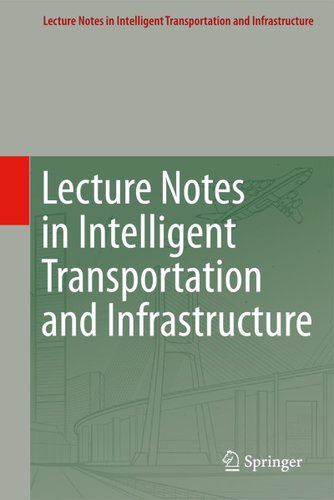
We are pleased to announce the call for papers for the proceedings of the TITDS-XV-2025 conference, "Smart Transport Networks and Systems: Transport Infrastructure, Territory Development, and Sustainability," to be published in the Springer book series Lecture Notes in Intelligent Transportation and Infrastructure (LNITI).
In an era of rapid urbanization and global digitalization, intelligent transportation systems and sustainable infrastructure have become critical drivers of progress. The advancement of these fields requires comprehensive, interdisciplinary approaches that merge cutting-edge engineering solutions, information technology, and the principles of sustainable development. This volume aims to provide a leading international platform for presenting the latest research findings and practical achievements in this dynamic and evolving domain.
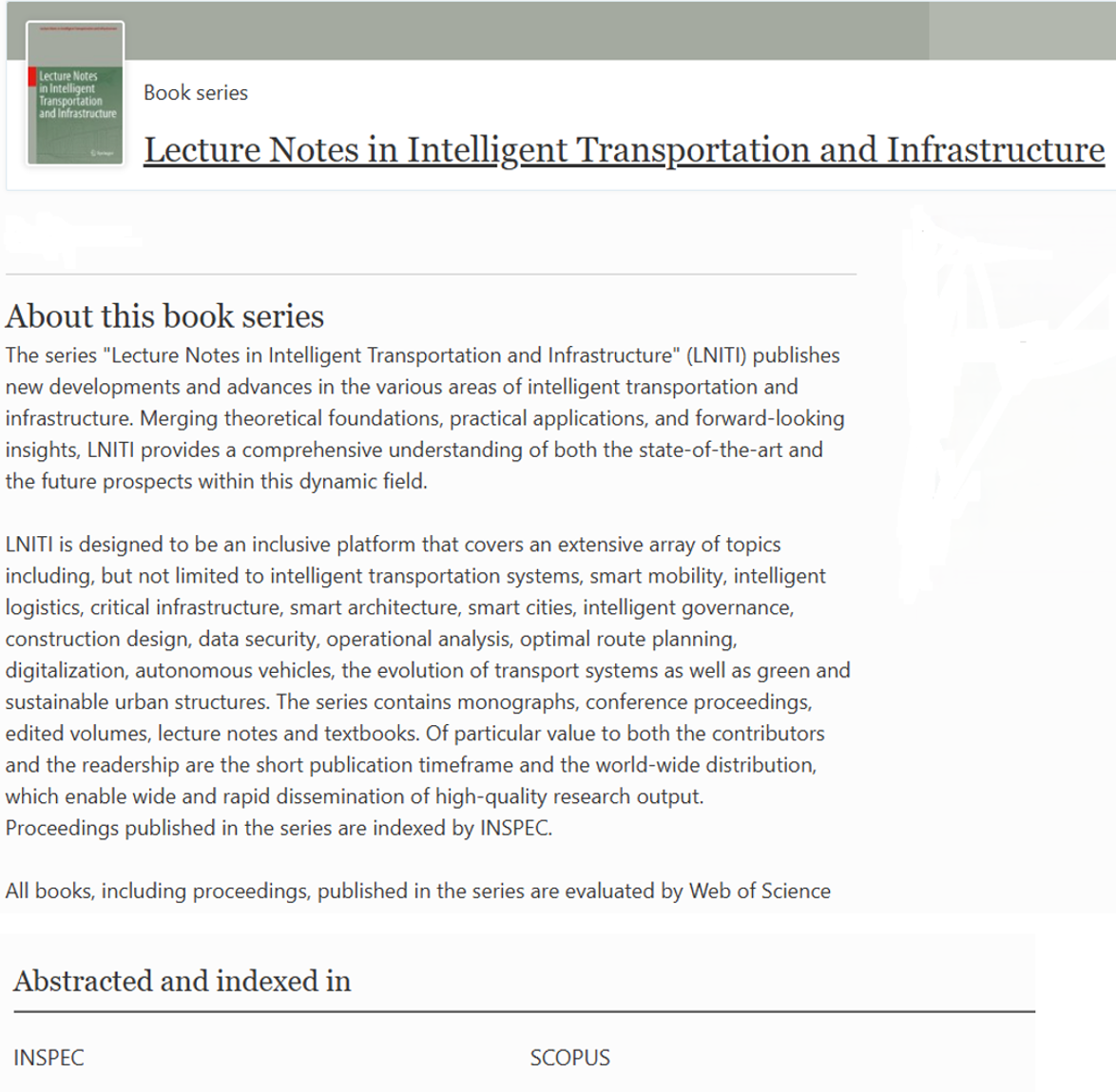
The series "Lecture Notes in Intelligent Transportation and Infrastructure" (LNITI) publishes new developments and advances in the various areas of intelligent transportation and infrastructure. Merging theoretical foundations, practical applications, and forward-looking insights, LNITI provides a comprehensive understanding of both the state-of-the-art and the future prospects within this dynamic field. The series is an inclusive platform covering a wide range of topics, including intelligent transportation systems, smart mobility, intelligent logistics, critical infrastructure, smart architecture, smart cities, digitalization, autonomous vehicles, and green and sustainable urban structures.
 Tashkent Transport University is the co-organizer of the volume.
We invite researchers, academics, and industry professionals to submit their original, unpublished work on a wide range of topics, including:
Publication in the LNITI series ensures worldwide dissemination and rapid indexing in leading scientific databases, including Scopus and Web of Science, guaranteeing broad visibility and international recognition for your research.
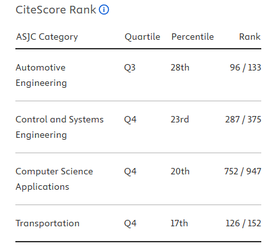
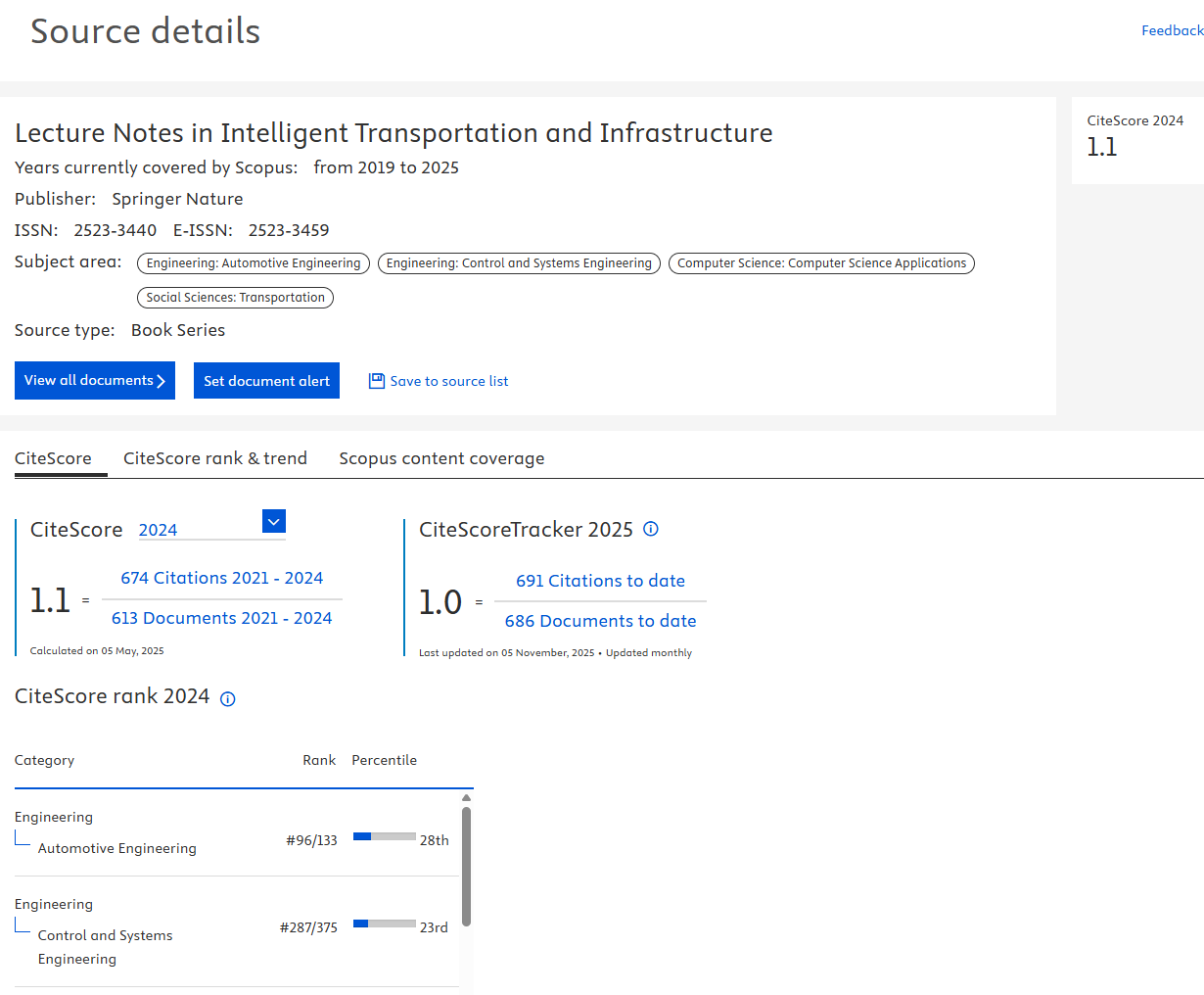
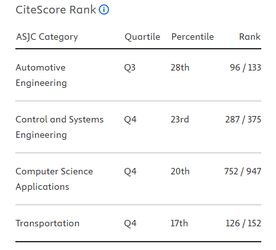
Lecture Notes in Intelligent Transportation and Infrastructure is indexed in the Scopus database and is part of the Springer book series. According to SCImago, the series does not have its own quartile ranking as it is not classified as a journal in SJR. Based on the CiteScore metric in Scopus, the series is ranked in Q3, and individual publications are indexed in author profiles as BOOK CHAPTER.
Submission Deadline: March 15, 2026.
The proceedings of the TITDS-2023 conference have been published in E3S Web of Conferences (Scopus) - Volume 471. The proceedings are indexed in Scopus.
The proceedings of the TITDS-XIII-2022 conference have been published in Transportation Research Procedia, volume 68, indexed in Scopus
The proceedings of the TITDS-XII-2021 conference have been published in Transportation Research Procedia, volume 61, indexed in Scopus
The conference has been held annually since 2009. Information and proceedings of previous conferences, information and proceedings of TITDS-XII-2021
Implementation of artificial intelligence and machine learning for traffic flow optimization, accident prediction, and route planning
Use of big data and intelligent data analysis technologies in logistics, forecasting, and real-time fleet management
Modeling and simulation, digital twins, and discrete-event simulation of transportation processes
Cybersecurity and information security of intelligent transportation systems
Application of the Internet of Things and digital twins for remote monitoring and predictive maintenance of transport infrastructure



|
The article is in English and formatted according to the publication's requirements. |
$ 290 |
Manuscript Formatting according the Publication Requirements |
$ 30 |
| Scientific Manusript Editting | $ 60 |
|
Translation of the Manuscript in the English language (up to 25 thous. characters; 10-12 pages in the template)
|
$ 90 |
|
Professional Editting of the Author's Translation |
$ 60 |
Requirements for Articles
Dear authors! We invite you to submit your scientific papers for publication in the prestigious series Lecture Notes in Intelligent Transportation and Infrastructure. To ensure a high quality of publications, please carefully review the following requirements:
Thematic relevance: The article must correspond to one of the announced topics of the collection.
Language: Articles are published in English. Submissions are accepted in English or Russian (articles in Russian will be translated into English for an additional fee of 9,000 rubles).
Structure: Mandatory sections include: Introduction, Materials and Methods, Results, Discussion, and Conclusion. A Acknowledgments section may be included if necessary.
Length: Minimum 10–12 pages in the publisher’s template, excluding the bibliography. Illustrations and tables should not exceed 25% of the total article length.
Authorship: Recommended number of authors is no more than 5.
The recommended length of a manuscript for publication in Lecture Notes in Networks and Systems is generally at least 20,000 - 30,000 characters including spaces.
Articles shorter than 15,000 characters including spaces will not be considered for publication.
The article length includes main text, tables, and figures, but excludes bibliography, title page, and abstract.
This requirement helps ensure sufficient scientific depth and topic coverage to meet the standards of international scientific publications of this class.
File format: Microsoft Word.
Formatting: Use the publisher’s template (see the template and instructions). Formatting by editors is a paid service (2,800 rubles).
Illustrations: Diagrams and tables are allowed but must be within the text boundaries.
Abstract: Minimum 100 words, maximum 200 words.
Bibliography: Minimum of 10 references, primarily articles from international journals.
Citations: Self-citations and citations of individual authors should not exceed one citation per author.
Originality: At least 80-85% originality.
Plagiarism: All articles undergo mandatory plagiarism checks using iThenticate. Please refer to the “Originality Check” section.
Peer Review: Double-blind peer review is applied.
License Agreement: All authors must read and sign the license agreement, which is submitted as a PDF after acceptance.
Third-party Content: Third-party content is any material in the manuscript that is not your original work. This includes text fragments, images, photos, poems, song lyrics, screenshots, etc. These may be found in various sources including but not limited to internet, printed and online books and articles, dissertations, reports, conference materials, photocopies, educational packages, and translations. Special attention should be paid to sensitive images featuring recognizable faces, logos, brands/trademarks, agency or internet images, as well as textual content such as song lyrics, poems, interviews, social media content, and references to commercial organizations. When third-party content is used, permission for its use must be provided (permission form is available in the “Templates” section).
Each author should be cited only once, regardless of their authorship status.
No more than one citation per edition is allowed.
The publisher discourages citations of publications from the same publisher.
The abbreviation “et al.” is prohibited for hiding author names; a full list of all authors must be provided for every reference.
Bibliographic entries must include surnames and initials of all authors, regardless of number.
References should be complete and accurate, containing all necessary information to identify the source.
The bibliography must include only sources that are directly cited or mentioned in the text.
Relevant and up-to-date sources related to the research topic are recommended.
If available, please include the DOI (Digital Object Identifier) for each article.
Formatting of the bibliography should follow the citation style accepted by the publication.
Focus: Describe the actual work done.
Structure: Start with the phrase “In this work (or study)…” Minimum of 5 sentences, maximum 200 words.
Language: Use active verbs such as analyzed, investigated, identified, studied, defined, established, formed, proposed, developed, justified, presented.
Content: Provide a concise summary of the article, not conclusions or justification of relevance.
Information content: The article should contain elements of informatics or mathematics (models, schemes, approaches, logical diagrams, programming languages, cryptography, architectures, etc.).
When using third-party content, a Permission for its use must be submitted:
Identify all third-party content in your manuscript.
Obtain written permission from the copyright holder for each piece of third-party content.
Use the provided Permission Form (available in the "Templates" section) for each item.
Fill out the Permission Form completely, including:
Description of the content
Source of the content
Copyright holder's information
Specific terms of use granted
Ensure the copyright holder signs the Permission Form.
Submit all completed and signed Permission Forms along with your manuscript.
Include proper attribution and citation for all third-party content in your manuscript.
Keep copies of all permissions for your records.
Remember: It is the author's responsibility to secure and provide all necessary permissions for third-party content. Failure to do so may result in delays in the publication process or removal of the content from your manuscript.

The public institution "Krasnoyarsk Regional Science and Technology City Hall of the Russian Union of Scientific and Engineering Public Associations" is a non-profit organization whose main goal is the development of scientific and engineering activities; additional education of children and adults, advanced training and professional retraining of specialists in various sectors of the economy and industry, medium and small business; creating favorable conditions for the exchange of scientific and technical ideas and achievements; promotion of modern achievements of science and technology; development of social entrepreneurship.
Krasnoyarsk Science and Technology City Hall has always been the centre of scientific, technical and educational events of the city. Every year more than 20,000 people visit it to participate in all kinds of events like conferences, workshops, seminars, exhibitions, lectures etc.
There are more than 30 resident companies in the building. The building has lecture halls, a big concert hall and 3 comfortable classrooms.
We are situated in Krasnoyarsk - the administrative center of Krasnoyarsk Krai, Russia. It is the third-largest city in Siberia after Novosibirsk and Omsk, with a population of more than 1,000,000 people.
The easternmost city of Russia with a population of at least million, located on the banks of the Yenisei River, and the capital of Krasnoyarsk Krai (district). The area is over 2 million square kilometers. Krasnoyarsk is a major industrial, cultural, economic and educational center.
Krasnoyarsk is one of the major scientific research centers of the country. The famous Krasnoyarsk Academgorodok is located in the city. It comprises seven scientific research institutes working in various fields.
The city is located 4,065 kilometers from Moscow along the Trans-Siberian railway. It takes about 2 days and 10 hours to get there from Moscow by train and about 4.5 hours by plane.
Krasnoyarsk is the center of the vast Krasnoyarsk region, it is the second biggest city in Siberia after Novosibirsk and a powerful industrial center.