Engineering Proceedings (MDPI) Paper
The 8th International Scientific Conference GeoTech-VIII 2027 welcomes original scientific papers presenting new results of fundamental and applied research, experimental studies, engineering developments, and technological solutions aligned with the scientific tracks of the conference and the scope of Engineering Proceedings (MDPI) .
General Requirements for Scientific Papers
- Manuscript type: Proceeding Paper.
- Publication language: English.
- Recommended length: 4–8 pages, including the abstract, figures, tables, equations, mandatory declarations, and references.
- The paper must be formatted using the official Engineering Proceedings (MDPI) template.
- The manuscript must present original scientific findings, novel engineering solutions, experimental data, or results of theoretical and computational modeling.
- The paper must align with one or more scientific tracks of the conference.
- Submitted materials must not have been previously published or be simultaneously under consideration by another scientific publication.
- All authors must have read the final version of the manuscript and approved its submission for consideration and publication.
The recommended length of 4–8 pages applies to a manuscript fully formatted using the official Engineering Proceedings template, rather than to an unformatted manuscript.
The suggested length of 4–8 pages refers to the formatted manuscript using the template.
Manuscript Template and Formatting
Authors must use the official Engineering Proceedings template to prepare their manuscripts. All formatting parameters, including margins, fonts, spacing, heading styles, and the placement of figures, tables, and references, must comply with the publisher's template.
Microsoft Word manuscripts must be submitted as a single editable file. When using LaTeX, authors must provide a ZIP archive containing all source files and images.
Authors should not modify the publisher's standard template layout, headers, footers, or administrative elements. All instructional text included in the template must be removed before submission.
Structure of a Scientific Paper
| Manuscript Section | Content Requirements |
|---|---|
|
Title Paper title |
A concise, informative, and specific title reflecting the content of the research. |
|
Authors and Affiliations Author and institutional details |
Full names of the authors, official names of their institutions, addresses, city, postal code, country, and email addresses. |
|
Abstract Research summary |
A single paragraph of approximately 100 words according to the template, not exceeding 200 words according to the general MDPI guidelines. The abstract should summarize the aim, methods, key results, and conclusions of the study. |
|
Keywords Index terms |
Three to ten keywords or phrases reflecting the scientific focus of the paper. |
|
1. Introduction Research background |
The relevance of the research, the current state of the problem, a review of scientific literature, the problem statement, the research aim, and the scientific significance of the study. |
|
2. Materials and Methods Research methodology |
A description of the materials, equipment, experimental setups, research methods, mathematical models, and software in sufficient detail to allow the results to be reproduced. |
|
3. Results Research findings |
Presentation of scientific findings, experimental data, calculations, graphs, tables, and engineering developments. |
|
4. Discussion Interpretation of findings |
Interpretation of the results, comparison with previously published studies, and assessment of scientific novelty, limitations, and engineering and practical significance. |
|
5. Conclusions Summary of findings |
The main conclusions, scientific findings, and prospects for practical application. A separate section is recommended. |
|
Declarations Required statements |
Author contributions, funding, data availability, conflicts of interest, and other statements in accordance with MDPI requirements. |
|
References Bibliography |
A reference list formatted in accordance with the Engineering Proceedings reference style. |
The Results and Discussion sections may be combined where scientifically and structurally appropriate. Additional sections may be included as necessary.
Author and Affiliation Information
- The given names and surnames of all authors must be written in the Latin alphabet, consistent with their publication profiles.
- Affiliations must be provided in English using the official names of the institutions.
- When multiple affiliations are listed, numerical superscripts must be used.
- The corresponding author must be marked with an asterisk (*) and an email address must be provided.
- It is recommended to provide ORCID identifiers for all authors.
- All individuals listed as authors must have made a substantial scientific contribution to the research.
Abstract and Keywords
The abstract must be written in English as a single paragraph without separate subheadings. The recommended length according to the template is approximately 100 words.
The abstract should address the following elements in sequence:
- Background: the relevance and aim of the research.
- Methods: the methods and approaches used.
- Results: the key findings obtained.
- Conclusion: the scientific conclusions and significance of the study.
The abstract must not contain unsupported results or overstated conclusions. References and unexplained abbreviations should be avoided.
The abstract must be followed by three to ten keywords separated by semicolons.
Requirements for Figures, Tables, and Equations
Figures, Graphs, and Schemes
- All figures and schemes must be numbered consecutively and cited in the main text: Figure 1, Figure 2, Scheme 1, etc.
- Figures should be placed close to their first mention in the manuscript.
- Figure captions must be placed below the images.
- All labels, captions, and legends must be in English.
- Recommended image formats: PNG, JPEG, and TIFF.
- The recommended image resolution is at least 600 dpi.
- Color images should preferably be provided in the RGB color space.
- Original image files must also be provided in a single ZIP archive.
Tables
- Tables must be editable and created using Microsoft Word or LaTeX.
- Tables must not be submitted solely as images.
- Tables must be numbered consecutively: Table 1, Table 2, etc.
- Table titles must be placed above the tables.
- Each column must have an informative heading.
- For large tables, a smaller font size may be used, but it must not be less than 8 pt.
Mathematical Equations and Notation
- Equations must be editable and created using Microsoft Equation Editor, MathType, or LaTeX.
- Equations should not be inserted as images.
- Equation numbers must appear in parentheses: (1), (2), (3).
- All variables and symbols used must be explained.
- The International System of Units (SI) should be used.
- A decimal point, rather than a comma, must be used in decimal numbers.
When using previously published illustrations or tables, the source must be acknowledged, and permission from the copyright holder must be obtained where required.
Mandatory Declarations and Additional Sections
The relevant statements and declarations must be provided in English after the main body of the paper and before the references, in accordance with the official MDPI template.
Supplementary materials may include datasets, software code, additional figures, tables, videos, and other files. This section should be included when such materials are available.
For papers with multiple authors, the individual contribution of each author must be specified using the CRediT taxonomy.
Contributions may include conceptualization, methodology, software, validation, formal analysis, investigation, visualization, writing and editing, supervision, and funding acquisition.
All sources of funding, official names of funding organizations, and grant numbers must be specified. Any funding covering publication costs should also be disclosed.
This research received no external funding.
With external funding:
This research was funded by [name of funder], grant number [grant number].
For research involving humans or animals, approval by the relevant ethics committee must be reported, including the protocol number and date of approval. For studies not requiring ethical approval, an appropriate statement should be used.
For studies involving human participants, a statement confirming that informed consent was obtained must be provided. Where this requirement does not apply, an appropriate statement may be included.
A statement on the availability of research data is mandatory. Authors must specify where the data supporting the study findings are available, including links to repositories and datasets.
If no new data were generated, or if legal, ethical, or other justified restrictions apply, an appropriate explanation must be provided.
The data supporting the findings of this study are included in the article.
Acknowledgments should recognize institutions and individuals who provided scientific, technical, administrative, or other support not covered by other declarations.
The use of generative artificial intelligence to create scientific content, data, or images, design the research, or analyze results must be disclosed in accordance with MDPI policy.
During manuscript preparation, the authors used [tool and version] to [describe the purpose]. The authors verified and revised the generated material and accept full responsibility for the published content.
Authors must disclose any potential financial, professional, personal, or institutional conflicts of interest that could influence the research findings or their interpretation.
The statements provided above are examples. Authors must adapt the declarations to the actual circumstances of their research. The Patents, Abbreviations, and Appendix sections may be added as necessary.
Reference List Requirements
- The reference list must be formatted in accordance with the MDPI (ACS) reference style.
- References must be numbered in the order in which they first appear in the manuscript.
- In-text citations must be given in square brackets: [1], [2,3], [4–7].
- Reference citations must be placed before punctuation marks.
- All sources listed in the references must be cited in the manuscript.
- For sources with a DOI, the digital object identifier must be provided.
- Recent peer-reviewed scientific publications directly relevant to the research topic are recommended.
- Unjustified self-citation, irrelevant sources, and citations of nonexistent publications should be avoided.
- Zotero, EndNote, or other reference management software is recommended for managing references.
Reference Formatting Examples
Journal Article
1. Author, A.B.; Author, C.D. Title of the article. Abbreviated Journal Name 2026, 15, 100–110. https://doi.org/xxxxx.
Book
2. Author, A.B. Title of the Book, 2nd ed.; Publisher: City, Country, 2025.
Book Chapter
3. Author, A.B. Title of the chapter. In Title of the Book; Editor, C.D., Ed.; Publisher: City, Country, 2025; pp. 25–40.
Conference Proceedings
4. Author, A.B.; Author, C.D. Title of the paper. In Proceedings of the Conference Name, City, Country, 20–22 January 2027.
Internet Resource
5. Title of Website. Available online: URL (accessed on Day Month Year).
These examples are illustrative and demonstrate only the structure of reference formatting.
Research and Publication Ethics
The Organizing and Scientific Committees of GeoTech-VIII 2027 adhere to the principles of academic integrity, MDPI publication ethics, and the recommendations of the Committee on Publication Ethics (COPE).
The following practices are not permitted:
- Plagiarism and improper appropriation of materials.
- Duplicate publication and simultaneous submission of the manuscript.
- Fabrication and falsification of scientific data.
- Manipulation of images and research findings.
- Listing individuals as authors who have not made a substantial scientific contribution.
- Unjustified citation and citation manipulation.
- Use of fabricated bibliographic references.
- Failure to disclose substantial use of generative AI.
Authors are responsible for the reliability of the submitted data, the accuracy of the results, the originality of the text, compliance with copyright requirements, and the validity of the scientific conclusions.
Manuscripts may be screened for textual overlap and other violations of publication ethics.
Use of Artificial Intelligence
The use of generative artificial intelligence (GenAI) tools must comply with the current MDPI policy.
- Artificial intelligence tools cannot be listed as authors of a paper.
- Substantial use of GenAI requires disclosure of the tool name, version, and purposes of use.
- The use of AI to generate scientific data or images, or to analyze or interpret results, requires appropriate disclosure.
- The use of tools solely to correct grammar and spelling or improve language quality does not require separate disclosure under MDPI policy.
- Authors must independently verify the accuracy of all materials prepared using AI.
- Authors bear full responsibility for the content of the manuscript.
Scientific Peer Review and Paper Selection
All scientific papers submitted for publication following GeoTech-VIII 2027 are subject to preliminary screening and independent expert peer review.
A single-blind peer review process is planned, with an average of two independent expert reviews per manuscript.
The main peer review criteria are:
- Relevance to the scope of the conference and the publication.
- Scientific novelty and originality of the research.
- Appropriateness and justification of the methods used.
- Reliability and reproducibility of the results.
- Engineering and practical significance.
- Quality of data analysis and interpretation.
- Validity of the scientific conclusions.
- Quality of academic English.
- Compliance with formatting and publication ethics requirements.
Based on the peer review results, a paper may be recommended for publication, returned for revision, or rejected.
Authors must provide a revised manuscript and responses to reviewer comments if such comments are received.
Selected papers are intended to be submitted for consideration and possible publication in Engineering Proceedings, subject to agreement with the publisher on the publication project and completion of the required editorial assessment.
Manuscript Submission Checklist
Before submitting the manuscript, ensure that the following requirements have been met:
- ✓ The paper is written in English.
- ✓ The official Engineering Proceedings template has been used.
- ✓ The recommended length of 4–8 pages after formatting has been met.
- ✓ An appropriate scientific track of the conference has been selected.
- ✓ Complete author and institutional information has been provided.
- ✓ A corresponding author has been designated.
- ✓ An abstract and 3–10 keywords have been provided.
- ✓ The manuscript follows the required scientific structure.
- ✓ Figures and tables have captions and are cited in the text.
- ✓ Equations and tables are provided in an editable format.
- ✓ References are formatted in the MDPI style.
- ✓ References and DOIs have been checked for accuracy.
- ✓ All required declarations and statements have been provided.
- ✓ Substantial use of generative AI has been disclosed, where applicable.
- ✓ All co-authors have approved submission of the manuscript.
- ✓ The paper is not under consideration by another publication.
- ✓ A Cover Letter has been prepared.
- ✓ The scientific content, grammar, and formatting of the paper have been checked.
The Cover Letter must briefly explain the scientific significance of the work and its relevance to the scope of the publication, confirm the approval of all authors, and state that the manuscript is neither under consideration elsewhere nor previously published.
Official Requirements and Useful Links
- Engineering Proceedings — Official Website
- Instructions for Authors — Author Guidelines
- Aims & Scope — Scientific Scope of the Publication
- Engineering Proceedings — Microsoft Word Template
- MDPI — LaTeX Template
- MDPI Author Layout Style Guide
- MDPI Publication Ethics and Research Data Policies
- CRediT — Contributor Roles Taxonomy
- Instructions for Conference Organizers
Participants of the GeoTech-VIII 2027 conference must use the official manuscript template of the international scientific publication Engineering Proceedings (MDPI) to prepare their scientific papers.
The template includes the publisher's prescribed formatting parameters, heading styles, scientific paper structure, and examples of formatting author information, figures, tables, mathematical equations, mandatory declarations, and bibliographic references.
Recommended Manuscript Length
The recommended length of a scientific paper is 4–8 pages after the manuscript has been fully formatted using the official Engineering Proceedings template. This length includes the main text, abstract, figures, tables, equations, declarations, and references.
The suggested length of 4–8 pages refers to the formatted manuscript using the template.
The recommended structure of a manuscript presenting original scientific research findings is as follows:
- Title — the title of the scientific paper.
- Authors and Affiliations — information about the authors and their institutional affiliations.
- Correspondence — contact details of the corresponding author.
- Abstract — a concise summary of the research.
- Keywords — keywords and phrases describing the research topic.
- Introduction — research background and objectives.
- Materials and Methods — research materials, methods, and procedures.
- Results — the findings of the research.
- Discussion — interpretation and discussion of the results.
- Conclusions — concluding remarks (where appropriate).
- Declarations and Statements — required declarations and statements.
- References — the list of cited bibliographic sources.
The following sections must be included at the end of the manuscript, as applicable, in accordance with the publisher's requirements and the nature of the research:
- Supplementary Materials — additional research materials, where available.
- Author Contributions — individual author contributions according to the CRediT taxonomy.
- Funding — information on research funding.
- Institutional Review Board Statement — information on ethics committee approval, where applicable.
- Informed Consent Statement — a statement regarding informed consent, where applicable.
- Data Availability Statement — a statement on the availability of research data.
- Acknowledgments — acknowledgments and disclosure of generative AI use, where applicable.
- Conflicts of Interest — a declaration of any conflicts of interest.
- Use the built-in Microsoft Word styles provided in the official manuscript template.
- Preserve the prescribed formatting parameters, page margins, fonts, and spacing.
- Provide the full names of all authors, their institutional affiliations, and the email address of the corresponding author.
- Complete the conference information footnote provided in the template.
- Place figures and tables close to their first citation in the main text.
- Provide mathematical equations and tables in an editable format.
- Number bibliographic references in the order of their first citation in the text: [1], [2,3], [4–7].
- Include Digital Object Identifiers (DOIs) for bibliographic sources, where available.
- Remove all sample and instructional text from the template before submitting the manuscript.
- Do not complete fields reserved for the publisher, including Academic Editor, Published, DOI, Volume, and Article Number.
- Save the completed manuscript in an editable Microsoft Word (.docx) format.
- Engineering Proceedings — Microsoft Word Template
- Instructions for Authors — Official Author Guidelines
- MDPI Author Layout Style Guide
- MDPI Publication Ethics
- Engineering Proceedings — Official Website
All manuscripts undergo mandatory originality screening using the iThenticate plagiarism detection system before submission to the publisher. The screening is conducted only after payment of the conference registration fee.
Manuscript Screening and Revision Process After Payment of the Registration Fee
High Similarity Index Detected:
If a high similarity index (exceeding 20%) is detected, the manuscript will be returned to the authors for revision. Authors will be given a limited period to make the necessary revisions:
- Revision deadline: 1–2 days to ensure timely inclusion of the manuscript in the conference proceedings.
Repeated Similarity Screening:
After revision, the manuscript undergoes an additional originality screening. The repeated screening is subject to a separate fee of 10 USD, payable by the authors.
Preliminary Similarity Screening
Authors may request preliminary originality screening of their manuscripts before paying the conference registration fee. This service is available for an additional fee and enables authors to assess the originality of their work in advance. Submit a Similarity Screening Request (service fee: 10 USD).
This approach enables authors to:
- Assess the quality and originality of their research manuscript.
- Make the necessary revisions before official submission.
- Increase the likelihood of successfully passing the mandatory similarity screening after payment of the conference registration fee.

Engineering Proceedings — международное научное издание открытого доступа (Open Access) издательства Multidisciplinary Digital Publishing Institute (MDPI, Швейцария), специализирующееся на публикации рецензируемых материалов научных конференций, симпозиумов и других научных мероприятий в различных областях инженерных наук.
Тематика издания охватывает широкий спектр фундаментальных и прикладных исследований, включая машиностроение, химическую инженерию, материаловедение, электротехнику, электронику, экологическую и биомедицинскую инженерию, компьютерные технологии и программную инженерию.
По итогам конференции оригинальные научные статьи, успешно прошедшие независимое экспертное рецензирование и отбор научным комитетом и редакторами сборника, планируется направить для рассмотрения и возможной публикации в международном научном издании Engineering Proceedings (MDPI) при условии согласования публикационного проекта с издательством и соблюдения его научных, редакционных и этических требований.

В базе данных Scopus издание Engineering Proceedings имеет тип источника Journal (журнал).
Для ранее опубликованных работ подтвержден тип документа Article (научная статья), несмотря на обозначение Proceeding Paper на сайте издательства MDPI.

- 2026 — Scopus · Elsevier Pure (Article)
- 2025 — Scopus · Elsevier Pure (Article)
- 2023 — Scopus · Elsevier Pure (Article)
Окончательный тип документа каждой новой публикации определяется Scopus при индексировании.
| Subject Category | CiteScore Rank | CiteScore Quartile | SJR Quartile |
|---|---|---|---|
| Industrial and Manufacturing Engineering | 251/425 | Q3 | Q3 |
| Electrical and Electronic Engineering | 633/1030 | Q3 | Q3 |
| Mechanical Engineering | 480/740 | Q3 | Q3 |
| Biomedical Engineering | 262/342 | Q4 | Q4 |
CiteScore (Scopus) и SJR (SCImago) используют разные методики расчета рейтингов и квартилей. Показатели обновляются ежегодно.
- Название: Engineering Proceedings
- Сокращенное название: Eng. Proc.
- Издательство: MDPI (Basel, Switzerland)
- E-ISSN: 2673-4591
- Scopus Source ID: 21101128137
- Годы охвата Scopus: 2020–2026 (по данным на ноябрь 2026 года)
- Тип источника в Scopus: Journal
- Тип документа для ряда индексированных публикаций: Article
- Формат рукописи MDPI: Proceeding Paper
- CiteScore 2025: 1.8
- CiteScore Best Quartile 2025: Q3
- CiteScoreTracker 2026: 2.3
- SJR 2025: 0.254
- SJR Best Quartile 2025: Q3
- SNIP 2025: 0.361
- Язык публикаций конференции: English
- Модель публикации: Open Access
Актуальный перечень баз данных, рейтинговых систем, агрегаторов и сервисов представлен на официальном сайте MDPI .
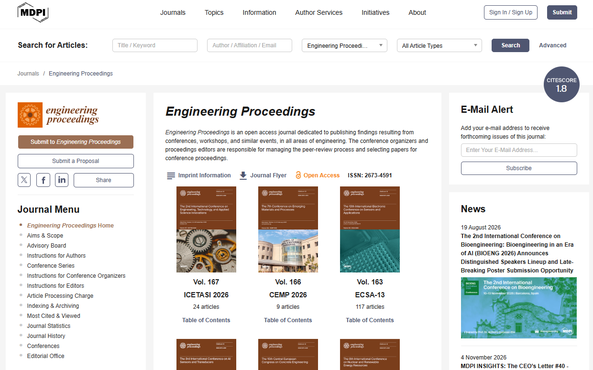
Нажмите на изображение для перехода на официальный сайт издания.
- Engineering Proceedings — официальный сайт журнала
- Aims & Scope — цели и научная тематика
- Indexing & Archiving — индексирование и архивирование
- Journal Statistics — статистика журнала
- Instructions for Authors — требования к авторам
- Scopus — Source ID: 21101128137
- SCImago Journal & Country Rank — SJR