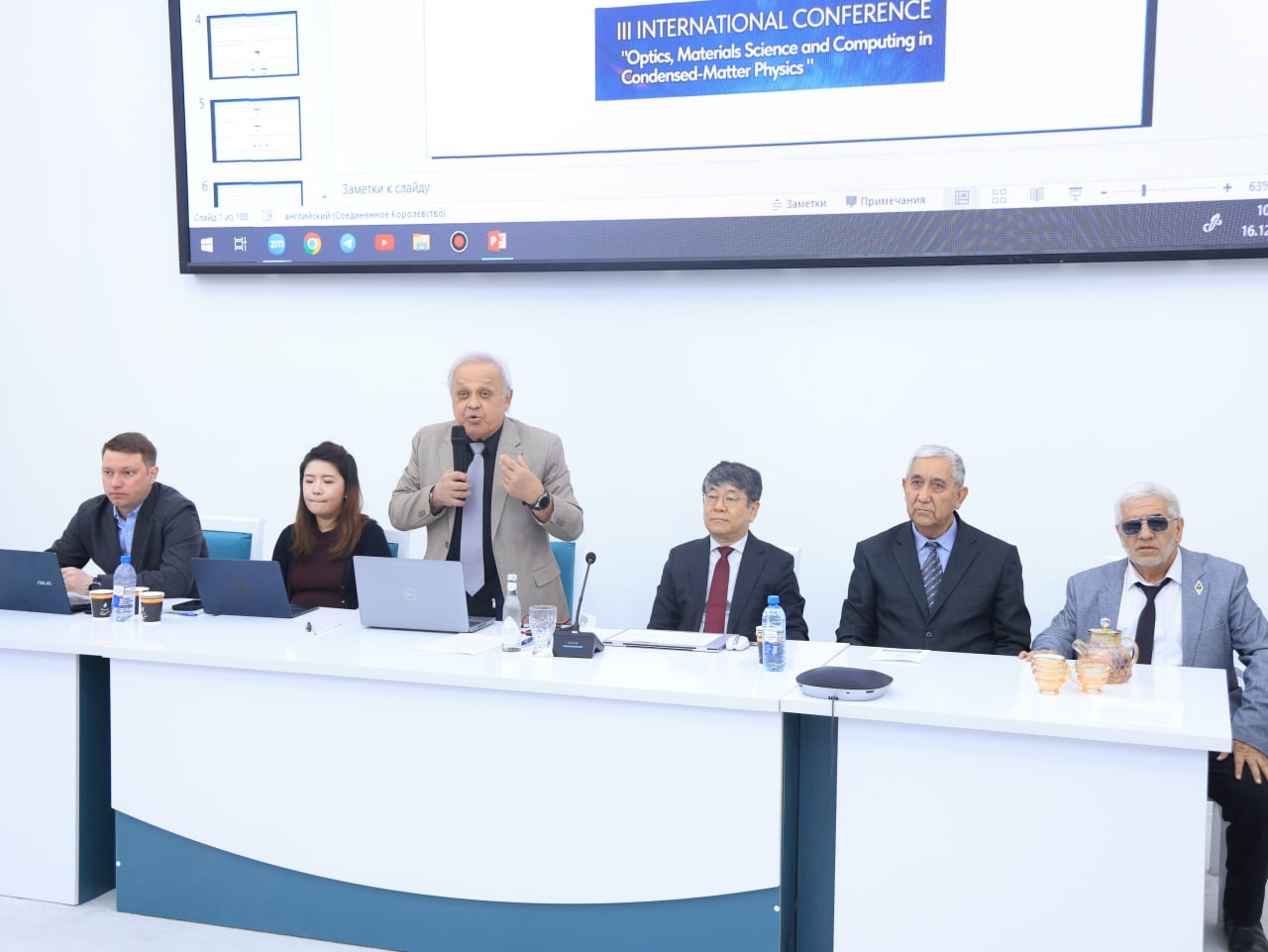
OPTICS AND PHOTONICS IN CONDENSED MATTER
- 14126 02 The use of fiber optic technologies in measuring low pressure in space life support systems
- 14126 03 Femtosecond laser amplification in Mgo:LiTaO3 crystals with modulated nonlinear characteristic
- 14126 04 The effect of thermal treatment on the absorption spectra of background impurity (oxygen and carbon) atoms in p-Si<B,Pt> structures
- 14126 05 Spectroscopic study of carotenoids contained in apricot juice
- 14126 06 Photoluminescence in lithium fluoride crystals exposed to 5MeV electrons at low temperatures
- 14126 07 Gas-laser cutting of carbon steel of U8G grade for gin saws
- 14126 08 Chemical analysis of steel slag by laser-induced decomposition spectroscopy analysis
- 14126 09 Eddy current method for studying the electrical conductivity of semiconductor materials
- 14126 0A Development of a method for calculating the gas-optically transparent liquid interfacial surface area based on a 2D image
- 14126 0B MO-LSRTDE for simulation-driven inverse design of visible-band thin-film antireflection coatings via transfer-matrix modeling
- 14126 0C A dual-beam photometer invariant to cuvette window contamination
MATERIALS SCIENCE: DESIGN, CHARACTERIZATION, AND APPLICATIONS
- 14126 0D Data-driven insights into oxidation and phase stability behavior of refractory high-entropy alloys
- 14126 0E Thermal evolution of impurity-induced energy levels in platinum-doped silicon
- 14126 0F One-dimensional micromagnetic domain structures and their physical nature in ferromagnetic crystals
- 14126 0G Physical and technological properties of fine-grained low-alloy steel 09G2S
- 14126 0H Microstructural characterization of 110G13L (Hadfield) steel by optical microscopy: matrix features, segregation contrast, and discontinuities
- 14126 0I Structural, tribological, and corrosion properties of Cr₃C₂-NiCr coatings obtained by the HVOF technique
- 14126 0J Physicochemical and histological foundations of soy whey-based fermentation in processing karakul skins
- 14126 0K Physical and technological properties of carbon steels using gas welding
- 14126 0L Industrial waste-derived geopolymer materials with curing-controlled microstructure and strength development
- 14126 0M Innovative method for studying the production of porcelain stone from local raw materials
- 14126 0N Data-driven multiobjective optimization of oxidation resistance and phase stability in refractory high-entropy alloys
- 14126 0O Improvement of tricot seams of various materials by modernization of sewing machine and polymer composite
- 14126 0P Mathematical modeling and numerical calculation of the thermal conductivity process of a sample during electrolytic-plasma hardening
COMPUTATIONAL AND THEORETICAL APPROACHES
- 14126 0Q Development of a neural network for controlling the chlorination process of recycled dichloroethane using a virtual analyzer
- 14126 0R Ionospheric concentration prediction model based on distribution images using ConvLSTM neural network in radio navigation
- 14126 0S AI-driven optimal control modeling for yield enhancement using nonlinear diffusion dynamics
- 14126 0T Mathematical foundations and algorithms for group decision systems
- 14126 0U Optimization of Bi-LSTM neural network parameters for named entity recognition in text data
- 14126 0V Analytical modeling of viscoelastic rotor dynamics with eccentricity and high-speed vibration effects
- 14126 0W Algorithm for fuzzy controlling the bioreactor block process of bacterial oxidation
- 14126 0X Modeling and machine learning for analyzing and predicting learning activities in robotics education
- 14126 0Y The occurrence of the phenomenon of elastic return during the unsteady flow of an elastic-viscous liquid in a flat channel
- 14126 0Z Security challenges and best practices in open-source software development
- 14126 10 Prediction of optimal thermal insulation thickness using an artificial neural network
- 14126 11 Machine-learning-based assessment of heating and cooling degree days for predicting building energy demand
- 14126 12 Real-time traffic forecasting and adaptive signal control with Python, Kafka, and ML
- 14126 13 Information properties of symmetric and nonsymmetric models
- 14126 14 Applying hybrid modeling and optimization techniques for teaching projection drawing with graphic programs
- 14126 15 AI-based Bellman optimization model for intelligent decision-making in agricultural systems
DEVICES AND TECHNOLOGIES
- 14126 16 Modeling and optimization of a disc-type digging mechanism for potato harvesters
- 14126 17 Research on methods to improve the accuracy of measuring the natrium cyanide concentration during the cyanization process
- 14126 18 Synthesis of the state observers of linear plants with elastic properties
- 14126 19 Visualization of the distribution of a physical quantity on a deformed interfacial surface
- 14126 1A Analysis of ADMET biological activity indicators of 1-(2-thienoyl)-3,3,3-trifluoroacetone acylhydrazones
- 14126 1B Parameters and operating modes of a device for cleaning the hull of pistachio nuts
- 14126 1C Performance assessment and excitation modeling of induction motors operated as standalone generators
- 14126 1D Use of innovative devices with alternative energy sources for the disposal of weeds
- 14126 1E Design and testing of an ejector-based device for continuous Trichogramma distribution in crop protection
- 14126 1F Design and kinematic analysis of a gear-lever differential transmission for roller processing machines
- 14126 1G A meter of electrical conductivity and magnetic field characteristics using an eddy current sensor
- 14126 1H Modeling and performance analysis of linear asynchronous drives for high-precision test bench systems
- 14126 1I Justification of the optimal parameters of a spherical disc working tool for the cultivation of sloping forest areas
INTERDISCIPLINARY TOPICS AND EMERGING TRENDS
- 14126 1J Сhange of values of maximum stresses in the cylindrical shell of the vessel housing in the presence of a dent
- 14126 1K Determination of the thermodynamic state of composite grinding wheels and the machined surface of rails during the grinding process
- 14126 1L Analytical assessment of the size of the zone of residual interblock movements
- 14126 1M Features of tool wear in the technological process of grinding railway rails
- 14126 1N Influence of technological residual stresses on the fatigue strength of machine parts
- 14126 1O Design of biodegradable chains and grease lubricants from mineral and vegetable oils
- 14126 1P Scientific basis for the restoration of the accuracy of the main surfaces of the gyrating shaft of cone crushers
- 14126 1Q Development of a screw conveyor with an improved design and methods for increasing its operational performance
- 14126 1R Structure of the elements of the discrete phase model of soil cutting by a three-sided excavator tooth
- 14126 1S Function of steel wire rope in an anchoring system
- 14126 1T Analysis of physical processes of passive particle transport and deposition in the atmosphere for the development of smart dust swarm technologies
- 14126 1U Prevention of tank cylindrical shell transition to limit state in case of edge displacement and corrosion wear
- 14126 1V Aerodynamic performance and design optimization of a dual-tier vertical-axis wind rotor
- 14126 1W Experimental analysis of tractor tire load and pressure effects on soil compaction
APPLICATIONS AND INDUSTRIAL PERSPECTIVES
- 14126 1X Determining the optimal insulation thickness for external walls and assessing its cost-effectiveness
- 14126 1Y Calculating the optimal thickness of polystyrene-based thermal insulation for the Kashkadarya region
- 14126 1Z Prediction of optimal tilt angle for photovoltaic systems using machine learning techniques
- 14126 20 Thermal analysis and performance modeling of radiation-based food drying in combined solar dryers
- 14126 21 Optimizing thermal insulation thickness for building walls in Uzbekistan’s climatic zones
- 14126 22 Modeling of building heat loss and environmental assessment
- 14126 23 Python-based analysis of optimal wall insulation and emissions in different climate zones
- 14126 24 Optimization of life cycle costs of external wall insulation for the climatic conditions of Bukhara and Jizzakh
- 14126 25 Numerical modeling of optimum insulation location based on time lag and decrement factor in wall systems
- 14126 26 Software development for an industrial takeaway order management system
- 14126 27 Modelling the environmental assessment of optimal insulation thickness in building envelopes
- 14126 28 Numerical modelling of optimal thermal insulation thickness considering energy and environmental performance
- 14126 29 Thermodynamic and electrochemical analysis of petrol-hydrogen blends for emission reduction in Otto engines
- 14126 2A Installation angle of the straightening section relative to the horizon
- 14126 2B Modelling solar radiation on tilted surfaces and determination of the optimum tilt angle
- 14126 2C Monitoring of train traffic safety using unmanned aerial vehicles and low-orbit satellite constellations